
Search for a farmhouse-style sink and you’ll land on the names Belfast and Butler. Often sold side by side, they both give you that same traditional look.
The two started out as slightly different designs and a couple of small differences still remain, if you know where to look. But today, it comes down to your kitchen and how you like to wash up.
This guide explains what a Belfast sink is, how it compares with a Butler sink and how to plan the taps, worktop, and cabinet around it.
What is a Belfast sink?
Most kitchen sinks drop into a cut-out in the worktop, so all you see from the front is the rim and the cabinet doors below.
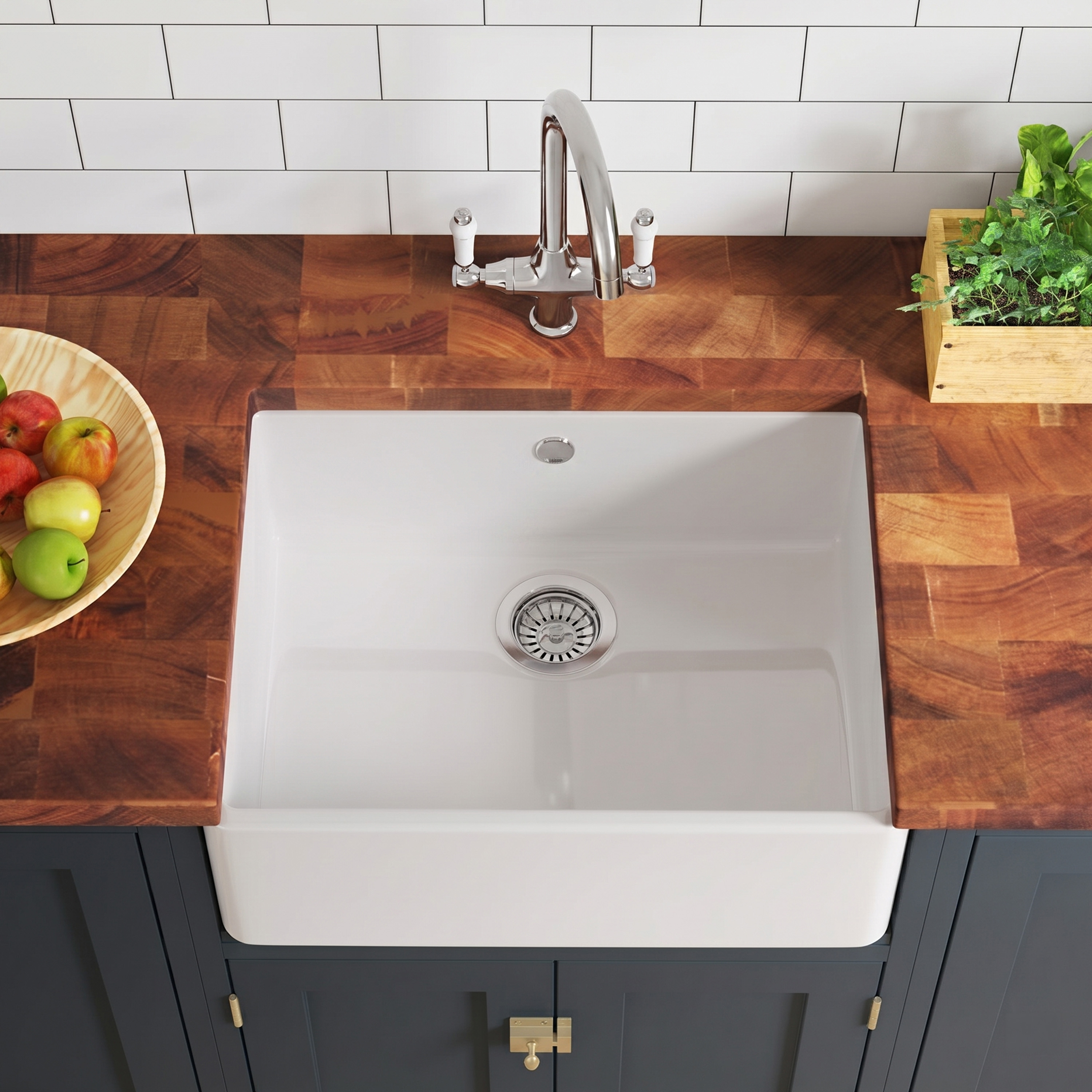
A Belfast sink sits on the top of the base cabinet instead. The worktop wraps around the back and sides, but the front is left open. What you see is a panel known as the apron front, and it’s the part everyone notices.
Take a closer look along the top of the rim, and you’ll find an open slot. That’s the weir overflow that allows water to escape if the bowl gets too full.
The other standout is depth. A Belfast sink is deeper than standard kitchen sinks, so a big pan or a pile of washing-up fits without a struggle.
It’s a look that started out in country kitchens, but that white ceramic front works just as well in a modern one.
Fancy something with a bit more character? The Butler & Rose Large Fluted Ceramic Fireclay sink comes with a fluted apron for a slightly different look.

Belfast sinks vs Butler sinks
The Butler sink takes its name from the butler’s pantry, the small service room in the big houses of London where the pots, pans and best glassware were washed.
It was a plain, sturdy ceramic sink built for a household where the washing-up never really stopped.
The Belfast sink came later. Makers in Belfast took the same design, gave it a deeper bowl and added the weir overflow, and the sink kept the city’s name.
Nobody’s quite sure why the Butler sink went without an overflow, but the story you’ll hear most is about water. In Victorian London, clean water was harder to come by, so not having an overflow meant none of it was wasted.
Belfast sits on the coast and had water to spare, so nobody minded a little running away.
Put the two next to each other, and the overflow is still the easiest way to tell them apart, although some modern Butler sinks now have one too. The bowl can give it away as well. A traditional Butler sink is broader and shallower, while a Belfast sink is often deeper.
Whichever name you’re searching for, you’ll find them together at Tap Warehouse. We keep Belfast and Butler sinks in a single category, so you can compare styles, sizes and bowl layouts without hopping between pages.


Single, double or 1.5 bowl Belfast sinks
Every Belfast sink gives you that deep bowl and apron front, but inside the rim there’s a choice to make. You can have one big basin, two equal ones, or a main bowl with a smaller one tucked in alongside.
Single bowl Belfast sinks
This design has one open basin with no divider in the way. If you love the traditional look, it’s also the version closest to how Belfast and Butler sinks were first made.
Double bowl Belfast sinks
Two full-sized basins side by side. Wash in one, rinse in the other or keep the second bowl clear for draining pasta or washing veg while the washing up waits to be done.
Some double bowls go a step further. The Butler & Rose workstation double Belfast sink gives you two deep bowls and comes with a chopping board and two sink grids so food prep can happen right at the sink.
1.5 bowl Belfast sinks
A full-sized basin for the heavy work, with a smaller half-size bowl that sits alongside it. So when the main side’s busy, there’s still somewhere to fill the kettle or rinse a mug.
The Thomas Denby Suffolk Belfast sink does without a weir overflow. Instead, the divide between the two bowls sits just below the rim. If the main bowl gets too full, the extra can tip into the half bowl and not over the apron front.
Material options compared
Give a fireclay Belfast sink a knock and you’ll hear how solid it is. But there are more choices available, and each material looks and wears a little differently.
| Material | Look | Day to Day |
|---|---|---|
| Fireclay | Glazed white, the classic Belfast finish | Kiln-fired at very high heat for a tough, chip-resistant glaze |
| Standard ceramic | Glossy white, close to fireclay at a glance | Copes well, a little less hard-wearing than fireclay |
| Composite | A flecked, stone-like finish | Hides everyday marks well |
| Stainless steel | A lighter, more contemporary take on the apron front | Suits a utility room or pared-back kitchen |
Fireclay and standard ceramic give you the classic glazed look. They’re dense, which is why they wear so well. Stainless steel goes the other way and offers the same apron front that’s much lighter in weight and in a different finish.
This Clearwater Belfast brushed stainless steel sink gives you the Belfast look with a modern twist in a single bowl made from 1.2mm gauge stainless steel.

Belfast sink sizes, taps and wastes
A standard single bowl Belfast sink usually suits a 600mm space, the same width as a regular kitchen unit. What it sits on is a little different.
Many kitchen ranges include a Belfast sink base unit, which is shorter than a standard cabinet so the sink sits on top at the right height. Otherwise, a fitter can build or adapt one around your sink, reinforced to make sure it can carry the extra weight.
Some sinks are wider, so check the specifications of the sink you have your eye on.
If you’re swapping to a double bowl in an existing layout, the cabinets either side will usually need adjusting to make room, along with the base cabinet to take the weight.
Double bowls are naturally wider, with most starting at around 800mm, so they need a wider base unit to sit on.
A 1.5 bowl is usually around the same width as a double bowl, so it sits on the same wider cabinet unit. The difference is in how that width is shared, with most of it going to the main bowl.
Taps need a bit more thought with a Belfast or Butler sink. Most have no tap holes, so often the tap is deck-mounted into the worktop behind the bowl. A swan neck spout is a popular choice for Belfast and Butler taps, as its tall arch leaves plenty of space to use easily without struggling to fit things under the running tap.
If you’d rather have the tap on the sink itself, the Thomas Denby Vintage Belfast 2 Bowl sink comes with a pre-drilled tap hole for a monobloc tap.
The waste is the other part that can be easy to overlook. It’s the fitting in the plughole and the pipework that carries water away to your drain.
Some Belfast sinks come with a waste included, but others don’t and the waste needs buying separately.
A sink with a weir overflow has a thicker base and needs a waste long enough to fit it, such as a weir strainer waste. Other wastes can also fit, so read the product details for the waste you are looking at to make sure it would be suitable for your sink. It's worth double-checking you have everything before your fitter arrives.
This all in one bundle takes the hassle out of shopping by including the Victoria kitchen tap and matching strainer waste right in the box, delivered together so your installation is effortless.
View Product PackWorktops and cabinets for a Belfast sink
With a standard inset kitchen sink, the rim sits on top of the worktop and covers the cut edges. A Belfast sink sits lower down, and the worktop is cut to fit around it. So that cut edge is left open, right where all the splashes land.
Cut laminate leaves its chipboard core on show, and once water gets in, the edge starts to swell and lift. Granite, quartz and solid wood cope far better, which is why they're the usual partners for a Belfast sink.
It’s a good idea to hold off cutting your worktop until your new sink arrives.
Every fireclay sink comes out of the kiln a touch different because it is a natural material, so the finished size can vary slightly. Check the product listing for details on the manufacturer's tolerances.
Once you have your sink you can take your measurements directly to make sure you get the best fit.
How heavy is a Belfast or Butler sink?
Another thing that needs to be considered with a Belfast or Butler sink is weight. These are heavy sinks!
A fireclay Belfast sink can weigh anywhere from 25kg to 60kg before you’ve run a drop of water. Some larger sinks can be even heavier.
Every litre of water adds around another kilo. Add dishes and pans in there too, and the cabinetry underneath that sink needs to be strong enough to cope with that load..
That means the cabinet needs a solid frame built inside it for the sink to sit on. This is the case whether it’s a single, double or 1.5 bowl sink. An experienced kitchen fitter can build this in for you, so mention this early to make sure everything is planned for.

Caring for a Belfast sink
Day to day, a Belfast sink asks for very little. A soft cloth and warm soapy water will do.
Scouring pads, wire wool and stiff brushes can all scuff the glaze, and bleach or strong acid-based cleaners can dull it. Vinegar and bicarbonate of soda can be gentle cleaners for other products, but both can leave marks on a Belfast sink, so are not the best choice when it comes to cleaning.
Fireclay handles heat well, but a sudden swing in temperature is hard on any glaze, so don’t put a pan straight into the sink from the hob. Give it a few minutes to cool beforehand to protect the glaze from any damage.
If you’re pouring boiling water away, run the cold tap first. This will help cool the water a little as it mixes in with the colder water left in the sink.
A little care goes a long way with a sink that’s had so much care put into making it. Many fireclay Belfast sinks are still finished by hand, and the heat of the kiln moves each one ever so slightly. It means no two sinks are quite the same.
Whether you’re drawn to a plain white fireclay front, a fluted apron or something in brushed stainless steel, you’ll find them side by side in our Belfast and Butler sinks range, with a full section of sizes and bowl layouts available to suit your kitchen.


